

Menu
Do you want to learn how to start making money blogging? Settle in with a cup of coffee, because this is going to be a long read, with links to even longer articles.
Warning: This is not for the lazy or unmotivated. Making money from blogging is entirely achievable, but a massive amount of work needs to go into it before you reap the rewards.
So how to start making money blogging? The short story is set up a blog, build traffic, establish a community, and start monetizing your traffic.
Simple, right?
Nope.
Each step is simple in theory, but each step is complicated. You’ll need skill, patience, and motivation.
Why, it’s almost as if you’re starting a business!
Well, it’s because you are.
The moment you decided to start a blog so you can make money, you became an entrepreneur, and your blog is your small business. Talk to entrepreneurs, and you’ll learn that they didn’t make their first hundred thousand overnight. Building a business takes time and dedication. This should be the mindset you have while you’re learning all of this. You need to be in it all the way.
Note: This is for those of you who don’t have a blog yet. If you already have a blog and are not looking to create a new one, click here to jump to how to promote your blog.

So you want to blog? You gotta start somewhere, and your niche is where you start. I’ve already discussed how to find your blog niche in greater detail, so you might want to check it out if you want more than just the basics.
The first questions you should be asking yourself are these:
Blogging is a marathon toward creating lots of content. Choosing a topic that you already have lots of ideas for or that you know you can write (and read) about day in, day out without getting sick of it would ensure that you still have fresh ideas months or years down the road. Chances are, this topic is something you already enjoy doing and talking about.
Writing about your passion sounds ideal, but you need to think about what your audience wants, too.
What can you do for them?

Readers stumble upon a blog because there’s a problem they want to solve. Can you offer them solutions? They have needs, and they’re looking to you to fill those needs.
So you’ve narrowed down your topics to the last few. Do you go where your passion is, or do you go where you stand to make money?
Writing about something you don’t even like is drudgery. But if people aren’t buying in the niche you’re pursuing, it will be so much more challenging to make a decent income from your blog.
My short answer? Compromise. Write about something you know, something you enjoy, that has a large enough audience that will likely pay money for products and/or services that you have to offer.

Chances are, there’s this one idea you’ll keep coming back to. Think about it some more. Don’t jump the gun on this decision, because it’s months, even years of your blogging life you’ll never get back again.
Contemplate a little more. Are you back to that one topic? That’s it. You’ve found your niche.
Still can’t decide? You might need a few more tips to help you make your decision. I suggest reading the exhaustive guide to finding your niche to help lead you to the right decision.
Now that you’ve decided on your blog niche, you’re now ready to build your blog. I’ve previously discussed how to build a blog from scratch in ridiculous detail. Here are the basic stuff you need to know.
As of June 2007, 28.3% of all websites use WordPress as their content management system (CMS), with a market share of 59.2% (Source). There are plenty of reasons why WordPress is popular, but here’s the short version:
I highly recommend starting with a self-hosted WordPress.org site. You can expect birthing pains at the onset, but eventually, you’ll have the freedom to make minor and major changes to your design and full control over how you make money from blogging. This allows you to evolve with your readers and maximize your income.
A web host provides services that allow your website to be available for everyone on the internet. They store (host) your website on their servers. Just doing a search for hosting providers will bring up many names, like InMotion, HostGator, and SiteGround, but we at StoppingScams.com highly recommend using Bluehost and will be using them in this article as an example.
Note: You can also read Ian’s step-by-step guide.
Click to Zoom
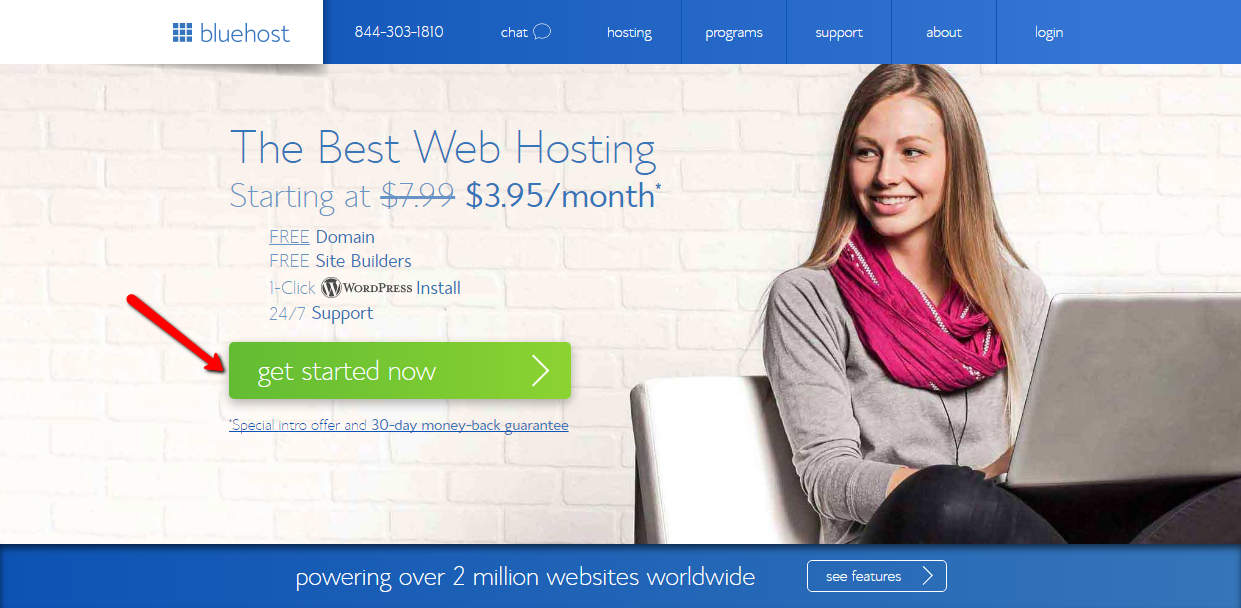
All you have to do is go to the Bluehost homepage and click on the “get started now” button. Choose your pricing plan (you can start with the Basic plan and upgrade later if you want to). Aaaaaaaaand you’re done. Right? Nope. You need to choose your domain name.
Quite simply, your domain name is your web address. For example, stoppingscams.com is this site’s domain name. You’ll want to think about this carefully because the first thing people think of when they encounter your domain will be the first thing people will think about you. You don’t want to be the next Pen Island Pens, do you?
Okay, quit giggling and let’s move on. Here are some tips when selecting your domain name:

Still stumped? TIP: Start with your name if it’s fairly unique.
When you have your domain name, you’ll have to register it with a domain registrar. Since you’ve already set up your hosting with Bluehost, you can also register your domain with them. I would recommend against doing this, though, because it will eventually cost more to buy your domain from them.
If you want to save, the more popular ones for beginners are Namecheap, GoDaddy, and iPage, but I would recommend using Namecheap because while they aren’t the cheapest option, they have the most reasonable rates and you get value for money.
So how do you register your domain name with Namecheap? Simply go to their homepage, search for the domain name you want to check if it’s available, click the add to cart button, and confirm your order.
You still with me? Good, because more technicalities are coming your way.
Why do we need to do it? Well, your domain name is your web address. You need to connect the web address to where your actual website files are saved, and that’s on the server of your web hosts. So how do we connect it?
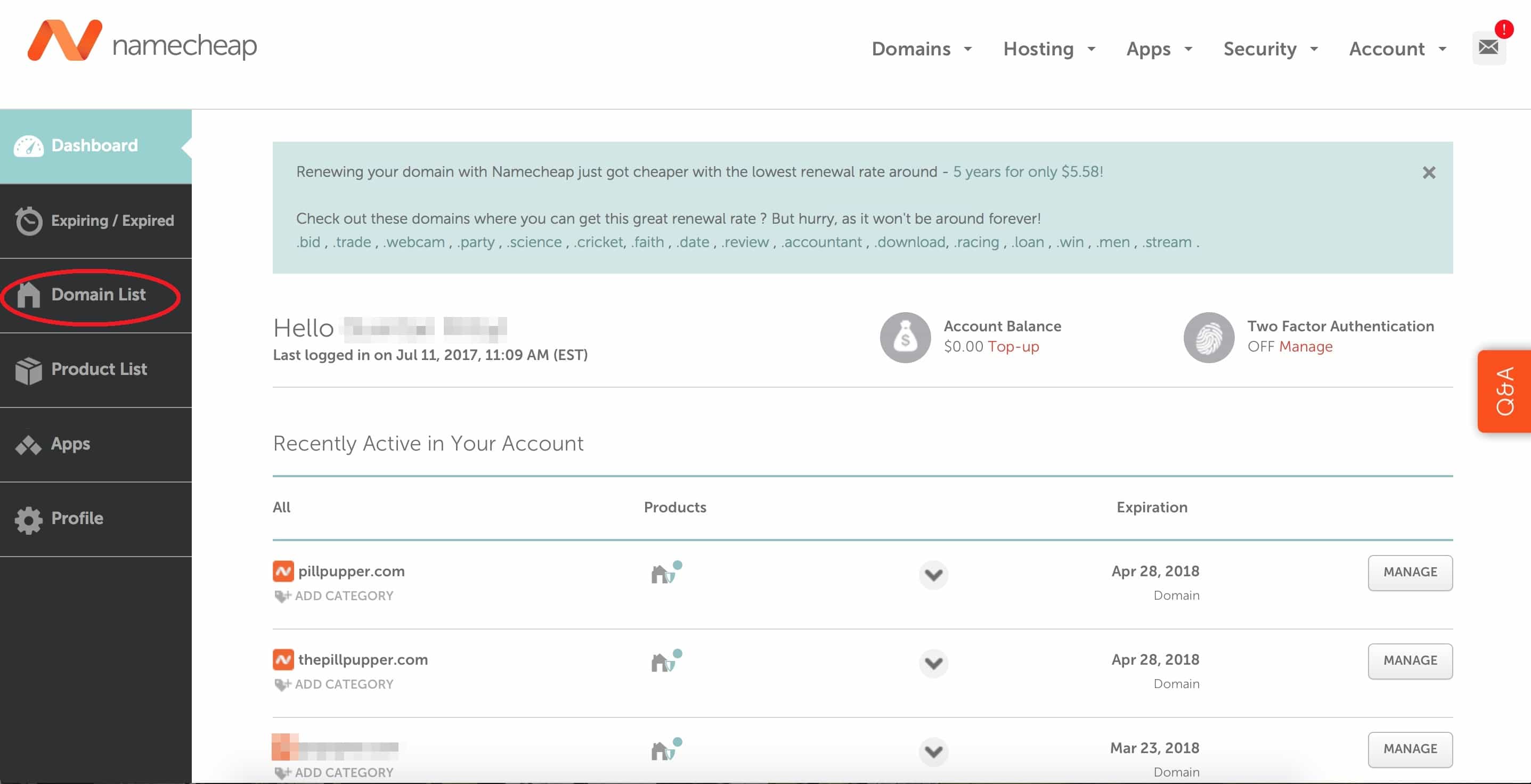
You update your nameservers in Namecheap. Your nameservers are provided by your host, in this case, Bluehost. Updating your nameservers in Namecheap tells it to connect to your website hosted by Bluehost when someone types in your domain name. That’s all it does.
Click to Zoom
Here’s how to do it:
Aaaaaaand you’re done. Really. I promise. That wasn’t so bad, was it? Congratulations, you now have your own blog!
Now what?
As we discussed, I highly recommend WordPress, and it’s a snap to install with Bluehost. Follow the steps from Bluehost to do it, or see the steps below:
Voilà! You now have a functional website that you can design.
WordPress offers lots of themes to choose from, and it might be overwhelming at first to choose color schemes, navigation menu placements, fonts, and all these website elements. The good news is that so many have gone before you, and with some Google skills and a bit of luck, you can find loads of themes, as well as detailed tutorials on how to tweak them as you go along.
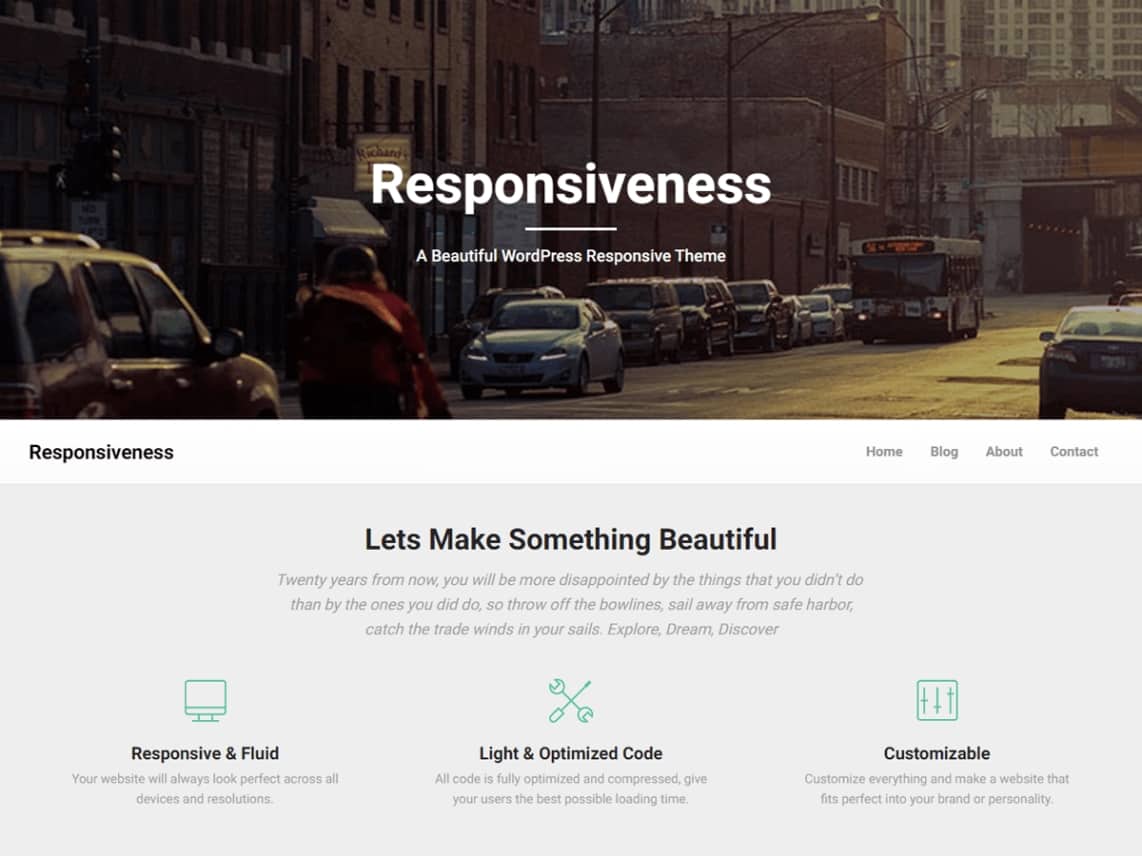
Image Created by writerstheme
The Responsiveness theme is one of the many free themes that WordPress.org has to offer.
Some important things to remember for now is to start with a simple, minimalist theme that’s mobile-responsive (i.e., easily read from smartphones and tablets). Having a simple theme to start with will help you mold your content to have lots of whitespace and breathing room.
Once that’s set up, you can now get on with creating content to go on your blog!
If you feel overwhelmed and could use a little more hand-holding, you can refer to the comprehensive guide for more tips and further explanations.
You’ve got your blog niche, you’ve set up your actual blog. Now comes the actual creating part.
I went into enormous detail on how to create content for your blog, but the main thing to remember is:
Create content for your readers.
It’s too easy to get lost in optimizing your blog post to be search engine-friendly and forget your readers. Remind yourself to write for humans before the machines. This means writing factual, relevant, and unique content that’s actually useful to your readers and will make a positive impact on their lives.

Now you have the why in place. Here’s the how.
With constant practice, you should be able to find your writer’s voice soon enough. The next thing you should pay attention to is the overall appearance of your written words. I’m not talking about the theme you used for your blog (although that will contribute somewhat). I’m talking about the way your text looks on your blog.
Studies have shown that readers scan online content, as opposed to reading it word-for-word, like you would a book. Because you’re writing for your readers, you’ll need to learn how to write so that your content is scannable. Here are some tips:
So you now have some kick-ass material for your readers. Something’s still missing, though.
You need to tell them what to do after reading your post.
No, your readers are not idiots. They’re just distracted. After you present them with your brilliant blog post, you don’t want them thinking “Yeah, okay, that’s helpful, but what do I do now?”
So direct them with great calls to action.

A call to action, or a CTA, tells your reader exactly what to do next. It could be something as trivial as following you on social media or as critical as buying your product. If you do this right, you can convert readers into subscribers or even buyers.
I’ve previously discussed what calls to action are and how to make great ones extensively, but here are the basic do’s and don’ts for making effective CTAs:
Before you hit Publish, some last things you need to do include proofreading and search engine optimization. Make sure you address your readers, especially toward the end. Pose questions and invite them to comment on your post. You get valuable feedback while they feel important. It’s a win-win situation!
Eventually, you’ll have some or a lot of content. If you paid attention to the key concept I pointed out at the start of this section, you now have a lot of useful content and hopefully established yourself as an expert in your niche by gaining your readers’ trust and confidence.
A steady base of regular readers is nothing to scoff at. However, an organic following can only earn you so much revenue. You’ll have to build a solid strategy for promoting your blog to gain more readers.
Promoting your blog is a tedious task, to put it kindly. Top bloggers spend about 3 to 4 times as much time promoting their blog posts as writing them. Let that sink in for a moment. That means if they spent 8 hours writing a blog post, they spend 24 to 32 hours promoting it.
That’s really daunting, but you don’t need to do all that right off the bat. Try just one or two techniques at a time, and add to those slowly.

Blimp not included.
Why you need to promote your blog:
I’ve previously listed 60 ways to promote your blog, and you can check it out. But if thinking about 60 different promotion tips is too much for you right now, I’ve grouped them into 7 categories. Below is a list of those 7 categories, with the most important tips for each category:
These are just 7 out of 60, so whenever you’re ready to apply more strategies, read up on them here.
Promoting your blog may feel icky at first, but you need to remember that it’s not about your ego, or about being famous, or about impressing others about your expertise. It’s all about building relationships. To succeed in that, you need to build trust, connection, and engagement, which you do when you’re promoting your blog with your heart in the right place; that is, when you have your readers’ best interests at heart.
After you’ve created and promoted your blog, you should have quite a following by now. By following, I mean visitors, regular readers, and subscribers. Now it’s time to earn money from that steady flow of traffic you’ve worked so hard to build.
I’ve discussed the best ways to monetize your blog in significant detail, down to the nitty-gritty. Below is a condensed version.
Having an actively engaged community within your blog is a prerequisite for a membership site to be successful. If your readers and subscribers seem to be interested in the content you are putting out, then a membership site may work for you. There are a number of ways to implement this, from a full multimodule course to single training videos, or even member-exclusive content upgrades on your blog posts.

Image Created by Matt | CC BY-SA 2.0
Some things to keep in mind when maintaining a membership site include:
Pros
Cons
Affiliate marketing is linking to a product or service that is for sale on another site, and when someone follows your link, you earn a commission if they input their contact details or if they buy that product or service. It’s one of the most popular ways of earning through a blog because it’s simple to implement and maintain.
Some things to keep in mind when doing affiliate marketing in your blog include:
Pros
Cons
Selling your very own products on your blog is the ultimate goal for most bloggers because while affiliate marketing can be lucrative, not having complete control over your product and your income may not be appealing.
Examples of products that you might consider creating and selling are:
Some things to keep in mind when selling products in your blog include:
Pros
Cons
If you are less into creating products and more into providing services, then this one might be a better fit for you. You can create a “Hire Me” page on your blog and look for clients immediately.
Some services you might offer are:
A few reminders when selling services in your blog:

Pros
Cons
Yes, it’s advertising, but no, it’s not the traditional method. In terms of your blog, the form that it will take would be either a sponsored post, wherein you publish an article that mentions the sponsoring company, or a review, wherein you review the company’s product or service.
Some things to keep in mind when creating sponsored posts include:
Pros
Cons
If you feel you’ll need a little more (okay, a lot more) information to decide on your monetization strategy, read the entire in-depth guide here
If you read this from beginning to end, congratulations. That was an awful lot of information to digest. I’d send you off on your way to starting your blog, but I have a few more things for you NOT to do.
It’s much more realistic to see your blog as a home base (Or lair. You do you.). From here, you can launch any number of projects that can provide income. On that note, you’ll probably start on one revenue stream, but don’t just rest on it. Once you’ve optimized that particular revenue stream, start developing a new one.
Running an online business means you have the entire internet as potential customers. This is a good thing for people who want to run a business but still have a flexible lifestyle. The bad news is that there will always be people who will exploit the internet’s potential and try to run business under shady or unethical practices, such as spamming, misleading ads, creating malware, or even conning people (I mean, it’s 2017 and the Nigerian prince scam is still ongoing).
Don’t be that guy (or girl).
Dedicate your time, effort, and smarts to producing quality information, goods, and services for your audience. If you do it right, you’ll definitely reap the rewards of your hard work sooner or later, and you get to sleep soundly at night.
Recognize that making money blogging is a long-term journey and not a get-rich quick scheme. Research on the most successful blogs and you’ll find that for most of them, it took years of hard work and plenty of missteps along the way. Indeed, some of them took mere months to earn 5 figures monthly, but that’s more of the exception rather than the rule.
Page rank, monthly traffic, social versus organic traffic, backlinks. These metrics are of course important to measure how your blog is performing, but it shouldn’t take away from your primary focus, which is building your audience.
Reading up on other blogs will show that most of them focus more on building their email lists instead of SEO and their backlinks. After all, your audience will be the ones who’ll spend money for what you have to offer. So focus on pleasing them, and it’ll translate to more income for you.
Even after it became almost standard for bloggers to publish their income reports, some people still say “blogger” with a certain condescension; as if it isn’t a “real job” or a “real business.” It’s heartbreaking, and it can certainly weaken your resolve to work on your blog.
But you know what? The most successful bloggers have become influencers in their respective fields. Chiara Ferragni of theblondesalad.com, Perez Hilton (real name Mario Armando Lavandeira, Jr.) of perezhilton.com, and Michael Arrington of techcrunch.com have all managed to become the ultimate influencers in their respective niches (fashion, entertainment, and tech startups, respectively).
You don’t have to aspire to their level of greatness, but remember that blogging and reaching an audience is having the power to change people’s lives. It may not be always in a big way, but to have a platform to inform, inspire, and support people in achieving their goals, one article at a time; that’s real power.
And the best thing about it is you earn income from changing peoples’ lives.
So chin up, blogger! Stand up and start on that journey today.

For easy reference, here are the five articles in this series about making money blogging. There are a lot of tips and techniques in these articles, and it’s a lot to take in one sitting. I suggest going over them in order on your own pace. It’s a good idea to bookmark this post right now so you can refer right back to it if you get lost.
I hope this article has helped and inspired you on your journey to make money from your blog. If you have any questions or suggestions, I’d love to hear from you! Hit me up in the comments.
JoAnne is your average, everyday, sane stay-at-home mom who believes in the power of the internet to make dreams come true. She has an insatiable appetite for chocolate, as well as all things internet marketing. She keeps up with the latest trends in blogging, affiliate marketing, e-commerce, and more.
